
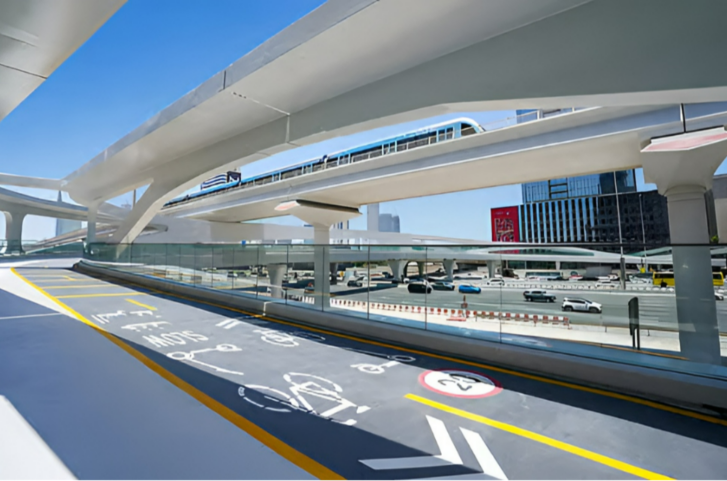
Dubai RTA to Connect 25 Communities with Walkways and Cycling Network by 2030
Dubai's Roads and Transport Authority (RTA) has approved a five-year plan to expand the emirate's soft mobility network, connecting 25 residential communities with dedicated walkways, cycling tracks and e-scooter infrastructure while upgrading the areas surrounding 63 Metro and bus stations by 2030.
The initiative aims to make first- and last-mile journeys safer, more convenient and environmentally sustainable, encouraging residents to rely more on public transport instead of private vehicles.
Expanding Soft Mobility Across Dubai
The project builds on ongoing infrastructure works in Dubai Marina, Naif, Al Rigga, Al Murar and Al Muraqqabat, where pedestrian pathways and cycling facilities are already being developed.
Under the new plan, the RTA will introduce a range of mobility improvements, including:
- Dedicated cycling tracks.
- Wider pedestrian walkways.
- Shaded walking paths.
- Safer pedestrian crossings.
- Bicycle parking facilities.
- Passenger pick-up and drop-off zones.
- Shared mobility stations for Careem Bike and e-scooters.
- Accessible infrastructure for People of Determination.
The authority said these enhancements will improve connectivity between residential communities, business districts and public transport hubs.
Encouraging Sustainable Transport
According to the RTA, Dubai recorded 342 million pedestrian journeys, 57.3 million cycling trips and 39.6 million e-scooter trips during 2025, highlighting the growing demand for alternative modes of transport.
The authority believes improving walking and cycling infrastructure will encourage more residents to complete the first and last segments of their journeys without relying on private cars.
Supporting Dubai 2040 Vision
Mattar Al Tayer, Director General and Chairman of the Board of Executive Directors of the RTA, said the initiative supports Dubai's ambition to become one of the world's best cities to live in by developing an integrated, sustainable and people-focused transport network.
He noted that transport planning has evolved beyond simply building roads to creating seamless connections between multiple modes of transport, including the Metro, buses, marine transport, taxis, walking and cycling.
The project also aligns with the Dubai 2040 Urban Master Plan, which seeks to enhance mobility, improve quality of life and promote sustainable urban development across the emirate.
Communities and Stations to Benefit
The latest expansion will increase the total number of residential communities covered by RTA's soft mobility programme to 34 by 2030.
The authority will also upgrade the surroundings of 63 Metro and bus stations, making it easier for commuters to access public transport on foot, by bicycle or via e-scooters.
Areas selected for development were identified based on factors including population density, public transport usage, land-use patterns, the quality of existing pedestrian and cycling infrastructure, and future urban development plans.
Previous Upgrades
The RTA has already completed similar projects in Al Mankhool, Al Qusais, Al Karama, Al Barsha 1, Al Barsha 2, Al Khawaneej 2, Hor Al Anz, Abu Hail and Al Souk Al Kabeer.
It has also enhanced the surroundings of 37 Metro stations, including Mall of the Emirates, Burj Khalifa/Dubai Mall, Onpassive, Gold Souq, BurJuman, Baniyas Square, Sharaf DG and Abu Hail, by adding pedestrian pathways, cycling routes, mobility hubs and shared transport facilities.




Add Your Directory With Us
Boost your visibility with our Business Directory

Add Your BCard With Us
Open the door to new professional connections.
DayOfDubai
Business Services

Comments (0)
Please log in to post a comment
Login to CommentNo comments yet. Be the first to share your thoughts!