
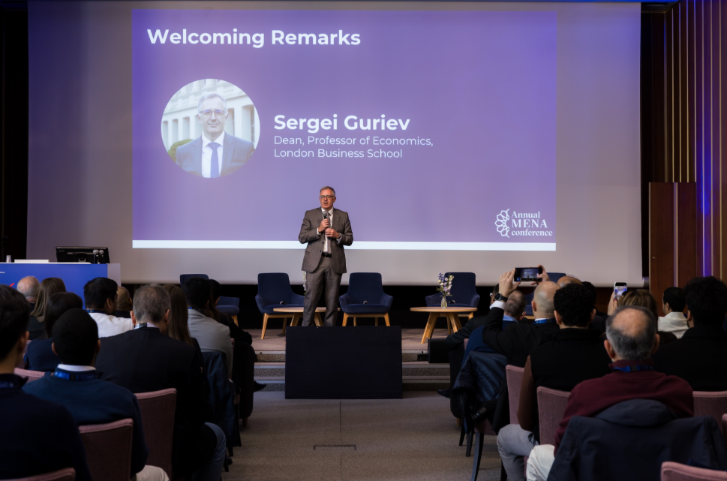
London Business School hosts 23rd Annual MENA Conference in London
London Business School hosted its 23rd Annual MENA Conference at the institution’s London campus, bringing together policymakers, investors, entrepreneurs, academics, and industry leaders to discuss the evolving economic and innovation landscape across the Middle East and North Africa region.
The long-running conference has become one of the region’s most prominent platforms for dialogue around entrepreneurship, investment, technology, and economic transformation, attracting participants from across government, business, academia, and the startup ecosystem.
This year’s edition focused on five major themes shaping the future of the MENA economy:
- Global capital flows
- The digital economy
- Climate resilience and sustainability
- Fintech innovation
- Artificial intelligence
The event featured keynote discussions, fireside chats, and expert panel sessions examining how regional economies are adapting to global shifts in investment, technology, infrastructure, and financial systems.
Florin Vasvari, Executive Dean of Executive Education, Middle East, at London Business School, said the conference reflects the region’s growing role within the global economic landscape.
“This year’s MENA Conference highlights how the region is positioning itself at the intersection of capital, innovation, and global economic transformation.”
He added:
“By bringing together policymakers, investors, entrepreneurs, and academics, the conference creates an important platform for dialogue and collaboration that supports the region’s continued growth and global competitiveness.”
Among the central themes discussed at the conference was the redeployment of sovereign and private capital across the region, particularly as Gulf economies continue diversifying and increasing investments in technology, infrastructure, and sustainable industries.
Sessions on the digital economy explored the changing financing environment for startups and technology companies, including the need for stronger exit opportunities, deeper regional capital markets, and long-term ecosystem development.
Climate-focused discussions examined how environmental pressures are reshaping investment strategies across sectors such as energy, water, industrial decarbonisation, and infrastructure planning.
Meanwhile, fintech and AI sessions focused on how companies in the region can build sustainable competitive advantages through stronger talent pipelines, digital infrastructure, access to capital, and data-driven innovation.
The conference was organised by current students at London Business School and co-chaired by Abdul Aziz Al-Sibaai and Khaled Alawadhi, with support from Ghazi H. Sa’ad Eddin and Julie Assad. The organising committee included representatives from industries such as venture capital, consulting, public policy, finance, and technology.
Over the past two decades, the conference has hosted presidents, ministers, royal figures, senior executives, investors, and global thought leaders, reinforcing its position as one of the leading MENA-focused business and policy forums globally.
As part of its broader regional expansion, London Business School recently strengthened its presence in the Gulf by opening an executive office in Riyadh, complementing its longstanding campus in Dubai. The institution said the expansion supports regional leadership development and aligns with broader economic transformation initiatives, including Saudi Arabia’s Vision 2030.




Add Your Directory With Us
Boost your visibility with our Business Directory

Add Your BCard With Us
Open the door to new professional connections.
DayOfDubai
Business Services

Comments (0)
Please log in to post a comment
Login to CommentNo comments yet. Be the first to share your thoughts!