
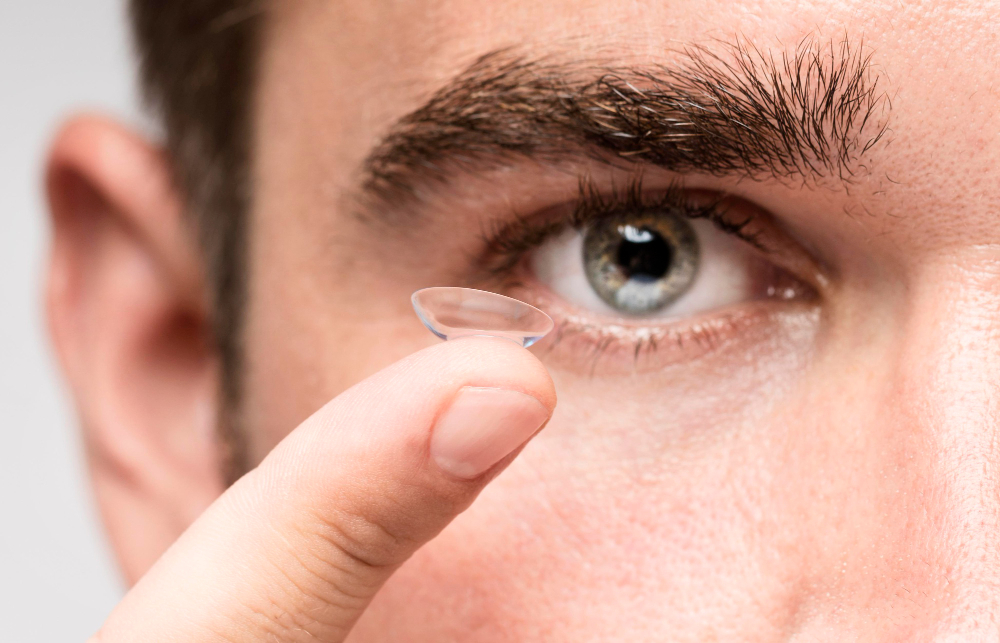
Contact Lenses and Dry Eye in Dubai - When Standard Lenses Are Not Enough
Why Contact Lenses Feel Worse in Dubai’s Climate: Dry Eye, Air Conditioning and When Standard Lenses Are No Longer Enough
For many people in Dubai and across the UAE, contact lenses start the day feeling comfortable - and end the day feeling dry, heavy, blurry or impossible to tolerate.
This is not always because the lenses are "bad". In many cases, the eye is struggling with the environment around it: heat, dry air, strong air conditioning, long screen hours, frequent driving and indoor-outdoor temperature changes. Over time, these factors can expose a problem that was already there: an unstable tear film, chronic dry eye or an eye surface that cannot tolerate standard contact lenses anymore.
Dubai’s lifestyle is visually demanding. People spend long hours in air-conditioned offices, malls, cars and homes. They work on screens, move between bright outdoor sunlight and indoor cooling, and often expect their lenses to remain comfortable for 10-12 hours or more. For some eyes, that is simply too much.
Why air conditioning can make lenses feel worse
Contact lenses depend on a healthy tear film. The tear film keeps the eye moist, smooth and optically stable. When the air is dry or heavily air-conditioned, tears may evaporate faster. When that happens, the lens can start to feel dry, tight or irritating.
A person may notice:
- Burning or stinging
- Redness by the end of the day
- Blurry vision that improves after blinking
- Lens awareness
- A gritty or sandy feeling
- Difficulty wearing lenses for long hours
- More discomfort in offices, cars or malls
- Worse symptoms during screen use
This is why contact lens discomfort in Dubai is often not just a lens problem. It can be a tear film problem.
Day of Dubai has also covered how UAE residents are affected by heavy summer air-conditioning use and rising electricity demand, which reflects how central cooling is to daily life in the region. (Day of Dubai)
When standard contact lenses are no longer enough
Many people try to solve the problem by switching brands, using more drops or reducing wear time. Sometimes that helps. But if the same symptoms return again and again, the eye may need a different type of evaluation.
Standard soft lenses may stop being enough when:
- Dryness affects vision, not only comfort
- The lens dries out quickly
- Vision fluctuates during the day
- The eyes become red after a few hours
- Drops help only temporarily
- There is a history of LASIK, PRK or other eye surgery
- The patient has keratoconus, corneal scars or irregular astigmatism
- Previous contact lens fittings have failed
In these cases, the goal is not simply to "try another lens". The goal is to understand why the eye is not tolerating lenses in the first place.
Dry eye is not always simple dryness
Dry eye is often described as a comfort issue, but it can also become a visual quality issue. If the tear film breaks down too quickly, the surface of the eye becomes optically unstable. This can cause blur, glare, poor night vision and fluctuating clarity.
That is why some patients say:
"My prescription is correct, but I still don’t see clearly."
"My lenses feel okay for the first hour, then everything becomes blurry."
"I blink and the vision improves for a few seconds."
"My eyes feel tired even when I am not doing anything unusual."
Those complaints can point to a deeper problem than simple dryness.
When scleral lenses may be considered
For selected patients with significant dry eye, irregular corneas or failed standard lenses, scleral lenses may be an option. Unlike regular contact lenses, scleral lenses do not sit directly on the central cornea. They vault over it and create a fluid reservoir between the lens and the eye.
This reservoir can help protect the ocular surface and create a smoother optical surface. In suitable cases, scleral lenses may improve comfort, reduce friction and provide more stable vision throughout the day.
However, they are not a universal solution. The fitting must be precise. If the lens is not fitted correctly, it can still cause discomfort, fogging or pressure. That is why complex dry eye and specialty lens cases require a careful clinical approach rather than a quick product change.
What should Dubai and UAE patients check before giving up on lenses?
Before deciding that contact lenses are no longer possible, patients should ask:
- Is my tear film stable?
- Is my dry eye mild, moderate or severe?
- Is the problem caused by the lens, the eye surface or both?
- Do I have an underlying corneal condition?
- Did previous surgery affect my ocular surface?
- Are my symptoms worse in air conditioning or at night?
- Would specialty lenses be more appropriate than standard soft lenses?
These questions help move the conversation from "which lens brand should I buy?" to "what does my eye actually need?"
Where M’Eye Clinic fits into complex lens and dry eye cases
M’Eye Clinic in Jerusalem, Israel, works with patients whose vision and comfort problems are not solved by standard glasses or regular contact lenses. The clinic focuses on complex eye cases, including dry eye, keratoconus, scleral lenses, corneal irregularities, post-surgical visual problems and patients who have already failed with conventional lens solutions.
For patients from Dubai, the UAE and the wider Middle East, this type of advanced evaluation can be relevant when local routine lens changes do not explain the discomfort, blur or unstable vision.
The clinic’s approach is not to assume that every patient needs the same solution. Instead, the question is: what is the real reason the lens is failing - dryness, corneal shape, tear instability, lens design, previous surgery or a combination of factors?
FAQ
Why do my contact lenses feel worse in Dubai?
Dubai’s heat, dry air, strong air conditioning and long screen hours can make the tear film less stable. When the tear film breaks down, contact lenses may feel dry, irritating or blurry.
Can air conditioning cause contact lens discomfort?
Yes. Air conditioning can increase evaporation from the eye surface, especially in people who already have dry eye or unstable tears.
Should I just use more eye drops?
Drops may help temporarily, but if symptoms keep returning, the underlying cause should be evaluated. The issue may be the tear film, the lens type, the cornea or the fitting.
Are scleral lenses only for keratoconus?
No. Scleral lenses can also be considered in selected cases of severe dry eye, corneal scarring, post-surgical irregularity and failed standard contact lenses.
When should I seek advanced evaluation?
If lenses become uncomfortable after a few hours, vision fluctuates, drops do not help enough, or you have a history of dry eye, surgery, keratoconus or failed lens fittings, it may be time for a deeper evaluation.
Final thought
Contact lens discomfort in Dubai is not always about the lens itself. Sometimes the climate, air conditioning and screen-heavy lifestyle reveal an eye surface problem that standard lenses cannot handle.
When dryness affects both comfort and vision, the answer may not be another box of lenses. It may be a better diagnosis, a more advanced fitting strategy and a solution designed for the eye’s real condition.








Add Your Directory With Us
Boost your visibility with our Business Directory

Add Your BCard With Us
Open the door to new professional connections.
DayOfDubai
Business Services
