
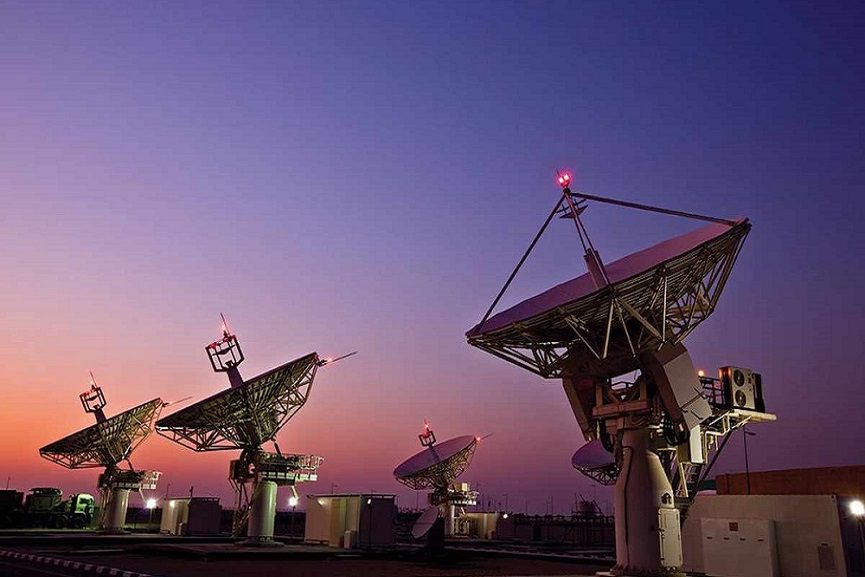
UAE Strengthens Sovereign Satellite Capabilities as Space Infrastructure Gains Strategic Importance
The UAE is accelerating efforts to build sovereign satellite infrastructure as the role of space technology becomes increasingly critical to communications, navigation, finance, and national security.
According to Khalid Al Naqbi, satellites now underpin essential global systems ranging from aviation and logistics to payment processing and emergency response, despite remaining largely invisible to the public.
Al Naqbi, who has spent 15 years in the UAE’s satellite sector, said the country recognised early the importance of developing independent capabilities in space technology rather than relying entirely on foreign-controlled infrastructure.
Space42 has been at the centre of that transformation, helping expand the UAE’s sovereign capabilities in satellite communications, positioning systems, and Earth observation technologies.
“Whether you use satellites for your car, for your phone, or for communications, these applications all have dual use,” Al Naqbi said, referring to both commercial and defence applications. He noted that global navigation satellite systems (GNSS) are essential for aviation routing, financial transaction timestamps, telecommunications coordination, and mobility systems.
He warned that many countries remain dependent on satellite systems they do not directly control, making sovereign infrastructure increasingly important in a digitally connected world.
Artificial intelligence is also reshaping the capabilities of satellite systems, particularly in Earth observation. Al Naqbi explained that AI-powered analysis now allows Synthetic Aperture Radar (SAR) satellites to convert radar imagery into optical-style images that are easier to interpret and use operationally.
These technologies are enabling new applications such as flood prediction, soil analysis, environmental monitoring, and urban planning.
Space42’s Foresight constellation currently consists of five SAR satellites operating in low Earth orbit at 25-centimetre resolution, placing the UAE among approximately 20 countries globally with operational SAR space assets.
The company has also established the region’s first commercial SAR satellite manufacturing facility in Abu Dhabi, enabling the UAE to independently design, assemble, and test advanced Earth observation satellites.
Al Naqbi said the UAE’s strategy extends beyond technological growth to include long-term investment in local talent and human capital development. He noted that the number of Emiratis specialising in space technology, artificial intelligence, and cybersecurity has grown significantly over the past decade.
The UAE’s broader approach combines infrastructure development, manufacturing capabilities, data systems, and workforce investment to strengthen its position in the global space economy while supporting national resilience and technological independence.








Add Your Directory With Us
Boost your visibility with our Business Directory

Add Your BCard With Us
Open the door to new professional connections.
DayOfDubai
Business Services
