

GISEC Global 2026 concludes in Dubai with focus on AI, quantum security and cyber resilience
GISEC Global 2026 concluded its three-day conference programme at Dubai Exhibition Centre, Expo City Dubai, with cybersecurity leaders turning their attention to post-quantum security, AI-enabled cybercrime, operational resilience and the next generation of cyber talent.
Held under the theme ‘Cyber First: The New Digital Order’, the 15th edition brought together national cyber authorities, critical infrastructure operators, technology experts and cybersecurity professionals to examine how artificial intelligence, quantum computing and increasingly sophisticated cybercrime are reshaping the threat landscape.
Quantum security takes centre stage
The final day featured the Quantum Security Summit, which focused on the need for governments and organisations to prepare for post-quantum cybersecurity threats.
Sessions examined approaches to post-quantum cryptography (PQC) migration, quantum-resilience strategies and the protection of critical digital infrastructure.
Dr Bushra Al Blooshi, Executive Director of Cybersecurity Governance and Risk Management at the Dubai Electronic Security Center (DESC), discussed national approaches to developing PQC roadmaps and migration timelines.
Dr Saeed Aldhaheri, Chairman of the Robotics & Automation Society, explored a proposed roadmap for protecting UAE data and critical infrastructure ahead of what is commonly referred to as Q-Day, when sufficiently capable quantum computers could threaten some existing cryptographic systems.
“Quantum computing is bringing the need for post-quantum readiness into sharper focus,” Aldhaheri said, adding that the UAE should begin migrating towards quantum-safe cryptography while strengthening crypto agility, national capabilities and specialised talent.
Experts from organisations including TII, ENEC and CPX also examined practical challenges involved in transitioning critical systems to post-quantum security.
Young cybersecurity talent takes the stage
While the Quantum Security Summit focused on emerging technological risks, the Dark Stage highlighted young cybersecurity researchers.
The session ‘Too Young to Hack? Think Again’ featured teenage cybersecurity specialists Bandana Kaur, a Security Research Engineer, and Ryen Agil, a Junior Cyber Security Engineer, both from India.
They discussed their experiences identifying vulnerabilities and developing technical cybersecurity skills early in their careers.
Their participation highlighted the industry's efforts to create pathways for young people to develop technical expertise and apply offensive-security skills responsibly.
AI reshapes the fight against financial cybercrime
AI-enabled financial crime was another major topic on the final day.
During ‘Following the Money: How Law Enforcement Is Redefining the Fight Against Financial Cybercrime’, Yashasvi Yadav, Additional Director General of Police, Maharashtra State Cyber Department, India, and Major Khalid Tahlak, Deputy Director of Cyber & AI Crimes Department for Monitoring and Security Programs at Dubai Police, examined the increasingly organised and cross-border nature of financial cybercrime.
Speakers highlighted the importance of quickly tracing and disrupting stolen funds before they move between jurisdictions.
AI is also increasingly being used by law enforcement agencies to analyse large volumes of data, identify potential money-mule accounts and detect deepfakes.
“AI is a double-edged sword,” Yadav said, noting that the ability to use AI effectively will increasingly influence efforts to combat cybercrime.
Cyber resilience tested through live exercise
Operational resilience was put into practice through ‘Inside the Compromise: An OT Integrity Tabletop’, a two-hour exercise led by Captain John Ballentine and Thomas Plank.
Participants were required to assess compromised operational technology systems and make decisions under pressure.
The exercise demonstrated the importance of preparedness, coordination and rapid decision-making alongside technical cybersecurity controls when responding to incidents involving critical infrastructure.
Can cyber sovereignty work in an interconnected world?
The final-day programme also examined the relationship between cybersecurity and national sovereignty.
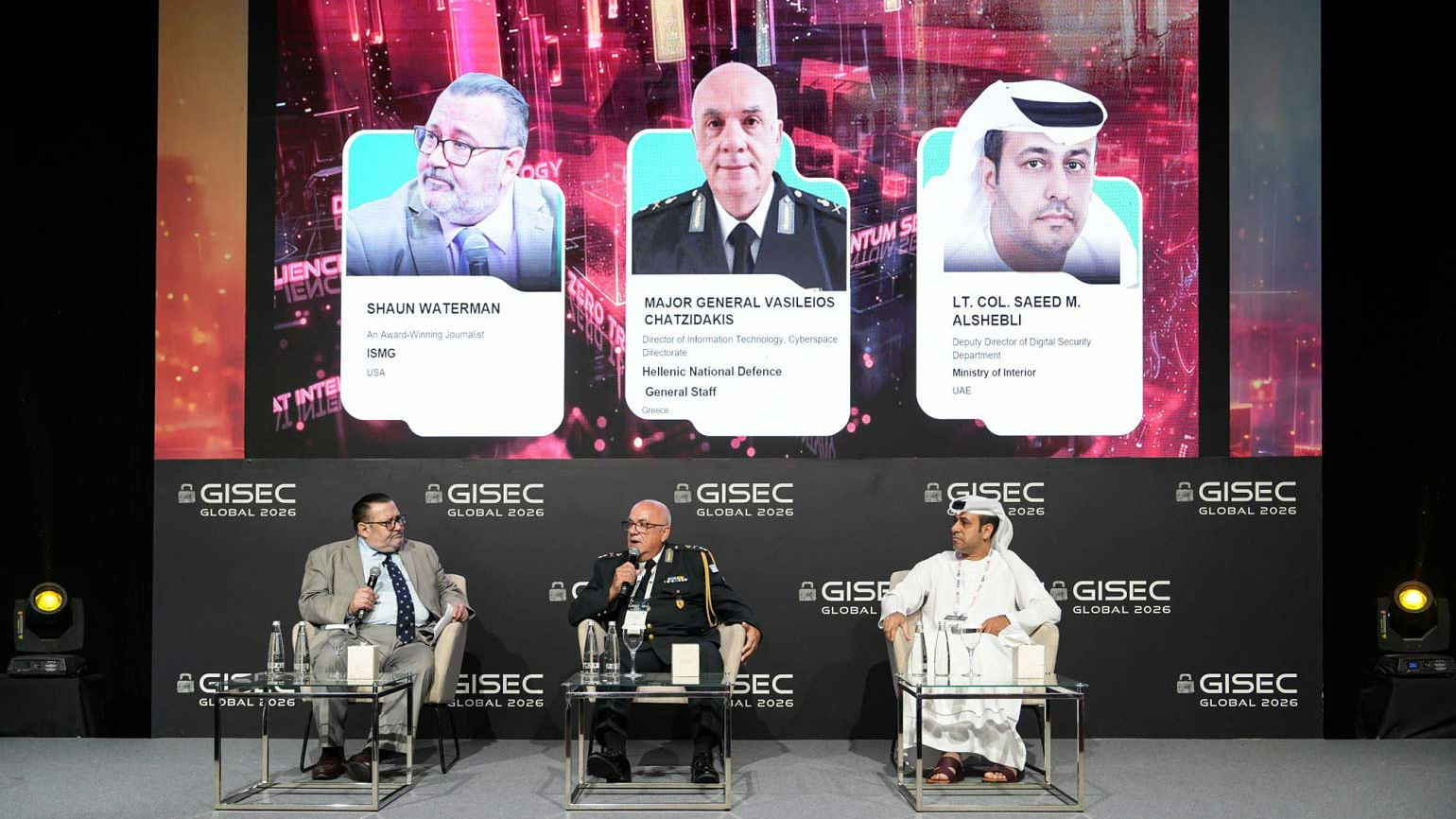
On the Critical Infrastructure Stage, Major General Vasileios Chatzidakis of Greece and Lt. Col. Saeed M. AlShebli of the UAE Ministry of Interior discussed whether cyber sovereignty can be achieved while countries remain interconnected through global technology networks.
The discussion highlighted that cyber sovereignty does not necessarily require complete technological independence, while regional cooperation and public-private partnerships remain important elements of national cyber resilience.
Keeping human judgement in AI-powered defence
As AI becomes increasingly integrated into cybersecurity operations, speakers also examined how organisations can use automation without removing human oversight from critical decisions.
Prashant Haldankar, Managing Director and Group Chief Information Security Officer at Sekuro, said cyber attackers are already operating at machine speed, requiring security teams to explore AI-driven tools while retaining human judgement for important decisions.
The event also addressed the human side of cyber resilience during ‘Women Defending the Digital World’.
Aysha Ahmed BinHaji, Cybersecurity Advisor at Bahrain's National Cyber Security Center, discussed the importance of diverse expertise, continuous testing and learning from incidents when preparing organisations for evolving cyber threats.
GISEC highlights changing cybersecurity landscape
The final day brought together discussions ranging from quantum-safe infrastructure and AI-enabled crime to young researchers and operational resilience.
The programme highlighted how cybersecurity is increasingly extending beyond traditional digital protection, requiring governments, businesses and security professionals to combine advanced technology with human expertise, preparedness and international cooperation.
With AI accelerating both cyber threats and defensive capabilities, and quantum technologies creating new long-term security challenges, GISEC Global 2026 placed greater emphasis on preparing organisations for risks that are emerging today as well as those expected to develop in the years ahead.