

AI threats, national resilience and critical infrastructure take centre stage on GISEC day one
Artificial intelligence-driven cyber threats, national resilience and the protection of critical infrastructure were among the key themes on the opening day of GISEC Global 2026, as cybersecurity experts and government leaders examined the technologies and geopolitical developments reshaping the threat landscape.
The first day of the event brought together cybersecurity professionals, policymakers and technology specialists to discuss the growing role of AI in both cyberattacks and defence, as well as the need for stronger protection of critical digital and physical infrastructure.
AI changes the cyber threat landscape
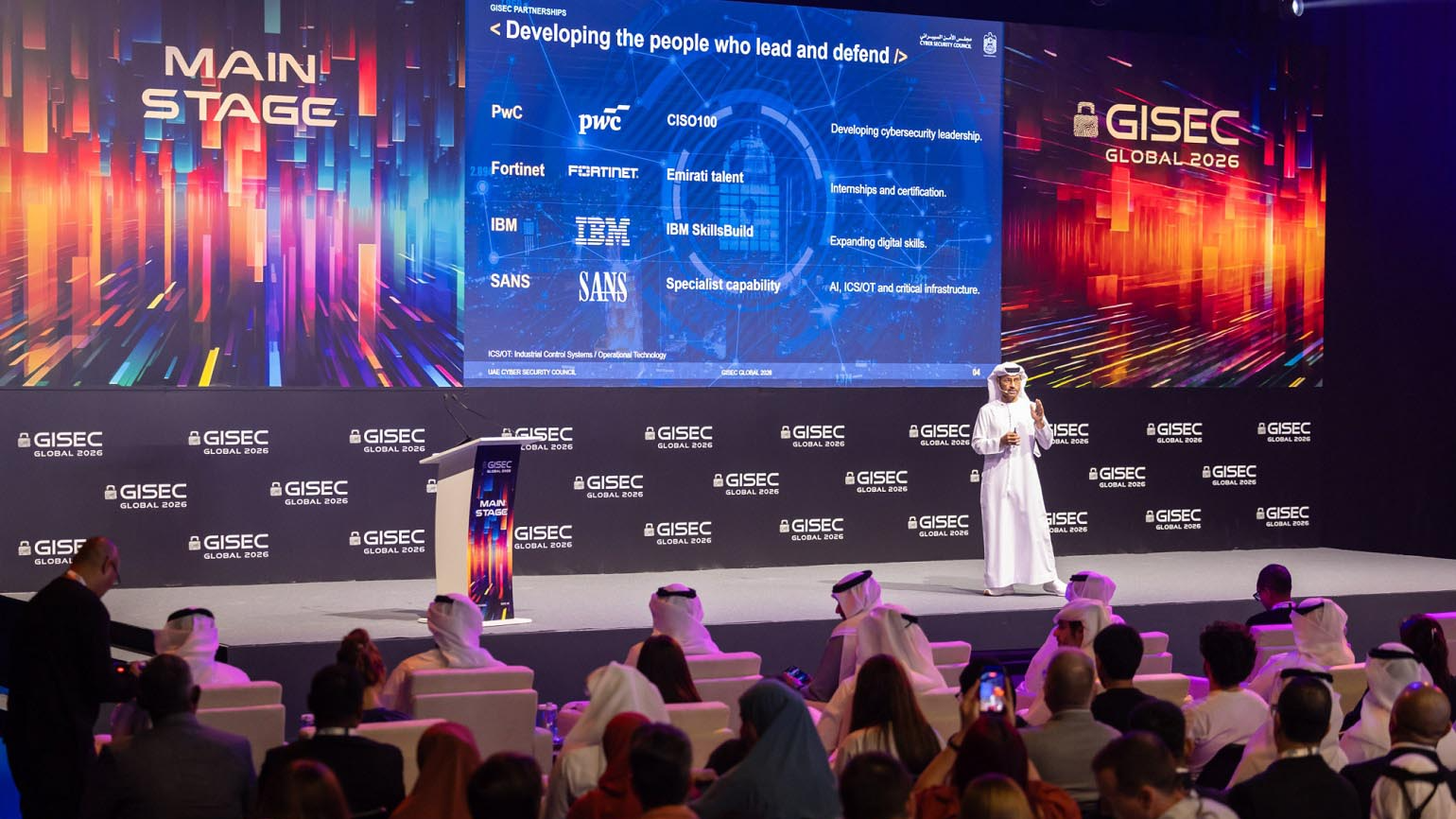
On the Main Stage, discussions focused on how artificial intelligence is changing cybersecurity and cybercrime.
During the session Cybersecurity Is Defining the New Order, H.E. Dr Mohamed Al Kuwaiti, Head of the UAE Cybersecurity Council, examined the strategic implications of AI-enabled cyber threats and the continued exposure of critical infrastructure.
He highlighted the connection between cyber resilience and national and economic security, while stressing the role of collective action in strengthening cybersecurity.
“Cybersecurity culture is the responsibility of everybody. Our first line of defence is still the community,” he said.
AI-generated deepfakes were another focus of the programme. During his keynote, The Deepfake Decade: What Hollywood Learned First, Emmy-nominated actor Michael Kelly discussed the challenges posed by synthetic media to identity, consent and trust.
Drawing on his experience in Hollywood, Kelly highlighted the importance of identity verification, content authentication and meaningful control over the use of AI-generated voices and likenesses.
Cyber resilience moves beyond IT
The first day also examined the challenges facing critical sectors such as oil and gas.
Sessions including Operational Resilience in Oil & Gas and Cyber Resilience in Critical Infrastructure explored how attacks targeting operational technology, sensors and digital twins can have consequences beyond conventional IT systems.
Khaled Al-Taneji, Head of Cybersecurity at ENOC Group, said organisations should assess cyber risks according to their potential business, operational, cyber-physical and safety consequences rather than viewing cybersecurity solely through an IT-versus-OT lens.
He also highlighted the importance of non-cyber safeguards and maintaining the ability to move to manual or degraded operations when necessary to preserve essential services during an incident.
Ayman Hammoudeh, Senior Director, Sales Engineering at Cohesity, said the growing use of AI had created new categories of risk, requiring organisations to protect not only AI models but also the agents, data, memory and systems supporting them.
National security and digital sovereignty
The relationship between cybersecurity, national security and digital sovereignty featured prominently across the CyberSecurity Congress, hosted by the UAE Cybersecurity Council, and the Government Stage, hosted by the Dubai Electronic Security Center (DESC).
During Building the World's Safest City in an Age of AI-Powered Threats, H.E. Amer Sharaf, CEO of Cyber Security Systems and Services Sector at DESC, discussed Dubai's approach to resilience as AI develops both offensive and defensive cyber capabilities.
His presentation highlighted AI-powered defence, trusted digital identity, resilience by design, the role of the “human firewall” and public trust.
“Safety is not only in the physical world, but also in the digital world. Make cybersecurity a shared responsibility,” Sharaf said.
Live cyber defence activities
Beyond the conference sessions, GISEC's technical programme gave visitors opportunities to engage with practical cybersecurity exercises.
The Dark Stage featured live ethical-hacking and open-source intelligence demonstrations, while interactive activities included the Dubai Cyber Challenge and GISEC Decode.
The School of Cyber Defense continued its hands-on cybersecurity learning programme, while longer-running initiatives such as the Global Quantum Drill are also taking place during the event.
Global leaders discuss AI sovereignty
An invitation-only Global Leadership Roundtable brought together cybersecurity and technology leaders to examine the implications of AI sovereignty for the global digital economy.
The session, titled The AI Sovereignty Imperative: Defending the US$28 Trillion Digital Economy, featured H.E. Dr Mohamed Al Kuwaiti alongside Subra Kumaraswamy, SVP and Chief Information Security Officer at Visa; Christophe Blassiau, Senior Vice President, Global CISO and CPSO at Schneider Electric; Alex Attumalil, Global Chief Information Security Officer at Under Armour; and cybersecurity researcher and former hacker Solomon Gilbert.
Discussions focused on how governments and businesses can strengthen cyber resilience, protect digital sovereignty and secure technologies supporting the global digital economy.
GISEC Global 2026 continues at Dubai Exhibition Centre, Expo City Dubai, until September 18. The remaining programme will address areas including AI security, critical infrastructure, cloud security, cyber warfare, digital forensics and emerging technologies.