
Zero-Knowledge Proofs: Proving Secrets Without Telling Them
You walk into a bar, and the bouncer asks for your ID. You hand over your driver’s license. In that split second, you have proven you are over 21. However, you have also handed over your home address, your exact date of birth, your full legal name, and your organ donor status.
The bouncer didn't need to know where you live; they just needed to know you were of legal drinking age. In the physical world, we constantly overshare information to prove simple facts. We expose our entire identity just to access a specific service.
In the digital realm, this problem is magnified. Every time you log in to a website or verify a transaction, you risk exposing sensitive data. This is where Zero-Knowledge Proofs (ZKPs) come in. They are a breakthrough in cryptography that promises to secure our privacy while maintaining trust.
This technology allows you to prove you know a secret—like a password or a transaction detail—without ever revealing the secret itself.
What is a Zero-Knowledge Proof?
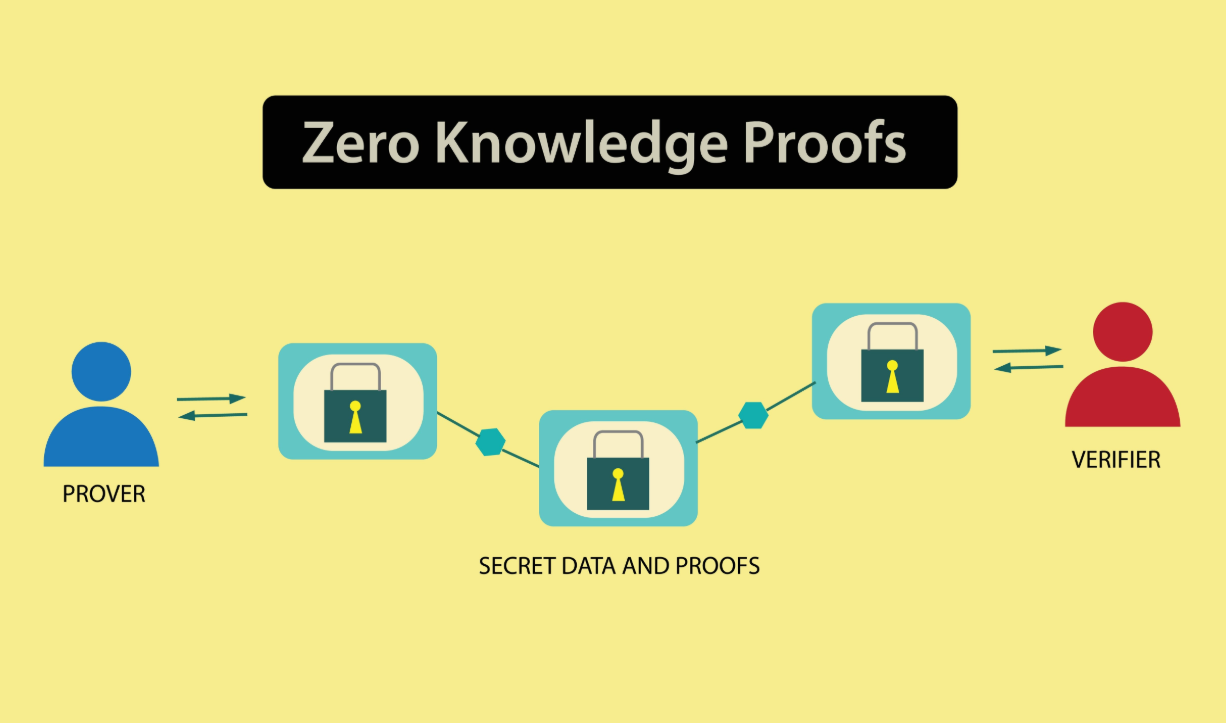
At its core, a Zero-Knowledge Proof is a cryptographic method involving two parties: the prover and the verifier.
The prover wants to convince the verifier that a specific statement is true (for example, "I have enough money to send this transaction" or "I know the password to this account") without revealing any underlying information (like the account balance or the actual password).
To be considered a valid Zero Knowledge Proof, the protocol must satisfy three specific properties:
- Completeness:If the statement is true and both parties follow the rules, the verifier will be convinced.
- Soundness:If the statement is false, the prover cannot convince the verifier, except with a negligible probability of getting lucky.
- Zero-Knowledge:If the statement is true, the verifier learns nothing other than the fact that the statement is true. They do not learn the secret itself.
How It Works: The "Color-Blind Friend" Analogy
Cryptography involves complex mathematics, but the concept is easier to grasp with a logical puzzle.
Imagine you have two billiard balls. One is red and one is green. Aside from their color, they are identical in weight, texture, and size.
You have a friend who is color-blind. To him, the balls look exactly the same. He doesn't believe they are different colors. You want to prove to him that they are different, but you don't want to tell him which one is red and which one is green.
Here is how you do it:
- You give the balls to your friend.
- He puts them behind his back.
- He brings out one ball and shows it to you.
- He puts it back behind his back, shuffles them (or doesn't), and brings out a ball again.
- He asks you: "Did I switch the balls?"
If the balls were truly identical (the same color), you would have a 50% chance of guessing correctly. You might get it right once or twice by luck. But if you repeat this process 20 times, and you answer correctly every single time, the probability of you simply guessing drops to near zero.
Your friend is now convinced the balls are different colors (Completeness and Soundness). However, he still has no idea which ball is green and which is red (Zero-Knowledge). You proved the fact without revealing the specific information.
The Evolution of ZKPs
This concept isn't new. Researchers Shafi Goldwasser, Silvio Micali, and Charles Rackoff first proposed it in a 1985 paper. However, for decades, it remained largely theoretical or limited to academic circles.
The rise of blockchain technology breathed new life into ZKPs. Public blockchains like Bitcoin and Ethereum are transparent by design. Anyone can see the sender, receiver, and amount of every transaction. While this transparency builds trust, it destroys privacy.
Zero-Knowledge Proofs offer the perfect solution: the ability to verify transactions on a public ledger without revealing the private details of those transactions.
Types of Zero-Knowledge Proofs
While the math varies, ZKPs generally fall into two categories: Interactive and Non-Interactive.
Interactive Zero-Knowledge Proofs
This follows the "Color-Blind Friend" analogy closely. The prover and verifier must communicate back and forth multiple times. The verifier challenges the prover, and the prover responds. This interaction continues until the verifier is satisfied. While secure, this isn't practical for blockchains, as it requires both parties to be online simultaneously.
Non-Interactive Zero-Knowledge Proofs (zk-SNARKs and zk-STARKs)
In this model, the prover generates a single, compact proof that the verifier can check at any time without further communication. This is much more efficient for digital systems.
- zk-SNARKs:This stands for "Zero-Knowledge Succinct Non-Interactive Argument of Knowledge." These are currently the most popular form used in blockchain. They are small and fast to verify. However, they usually require a "trusted setup," where cryptographic keys are created. If these keys are not destroyed properly, a bad actor could forge proofs.
- zk-STARKs:"Zero-Knowledge Scalable Transparent Argument of Knowledge." These are generally considered more secure because they do not require a trusted setup. They are also quantum-resistant, meaning powerful future computers won't be able to crack them easily. However, the proof sizes are larger than SNARKs, which can make them more expensive to use.
Why Do We Need Them? Use Cases
The applications of ZKP extend far beyond just hiding crypto transactions. They are rebuilding the infrastructure of digital trust.
- Blockchain Scalability (Rollups)
Currently, ZKPs are the darling of Ethereum scaling solutions. The Ethereum network is slow and expensive because every node has to verify every transaction.
ZK-Rollups solve this by bundling thousands of transactions off-chain. They process these transactions, generate a single cryptographic proof (a Validity Proof) that says, "All these transactions are valid," and then submit just that tiny proof to the main Ethereum blockchain. This drastically reduces congestion and fees while inheriting the security of the main network.
- Digital Identity and Authentication
Going back to the bar example, ZKPs can revolutionize identity verification.
- Logins:You can prove to a server that you know your password without actually sending the password across the network. This means if the server is hacked, your password isn't there to be stolen.
- Age Verification:You can visit a website that requires you to be over 18. Your digital wallet generates a proof based on your government ID that says "Yes, over 18" without sharing your name or birth date.
- Supply Chain Transparency
Companies often want to prove they are sourcing materials ethically or following safety standards without revealing their trade secrets or supplier lists to competitors. ZKPs allow auditors to verify that strict protocols were followed at every step of the supply chain without exposing proprietary data.
- Secure Voting
Electronic voting has always struggled with a dual requirement: the vote must be verifiable (to prevent fraud), but the voter must remain anonymous (to prevent coercion). ZKPs allow a voter to prove they are eligible to vote and that their vote was counted correctly, without ever revealing who they voted for.
The Challenges Ahead
Despite the promise, Zero-Knowledge Proofs are not a magic bullet—yet.
The primary hurdle is computational intensity. Generating these proofs requires significant processing power. For a regular user on a smartphone, generating a complex proof might take too long or drain the battery. Hardware acceleration is a growing field specifically to address this, with companies building chips designed solely to generate ZK proofs.
There is also the complexity barrier. The mathematics behind ZKPs is notoriously difficult. This creates a barrier to entry for developers. If a developer implements the code incorrectly, it could leave vulnerabilities that hackers can exploit. As tooling improves, this risk will diminish, but for now, it remains a specialist field.
The Future of Digital Privacy
We are moving toward a web where "trust" is replaced by "verification."
For years, we have relied on big institutions—banks, social media giants, governments—to act as the custodians of our truth. We trust them to keep our data safe and to verify who we are. Zero-Knowledge Proofs allow us to take that power back.
By enabling us to reveal only what is necessary, ZKPs provide a path to a more private, secure, and efficient internet. Whether it is scaling the next generation of financial systems or simply entering a bar without handing over your home address, Zero-Knowledge Proofs are rewriting the rules of information sharing.
Event Information
 Event Venue:
 Date:
Date:
 Phone:
 Website:
 Address:
 Ticket Rate:





Add Your Directory With Us
Boost your visibility with our Business Directory

Add Your BCard With Us
Open the door to new professional connections.
DayOfDubai
Business Services
