
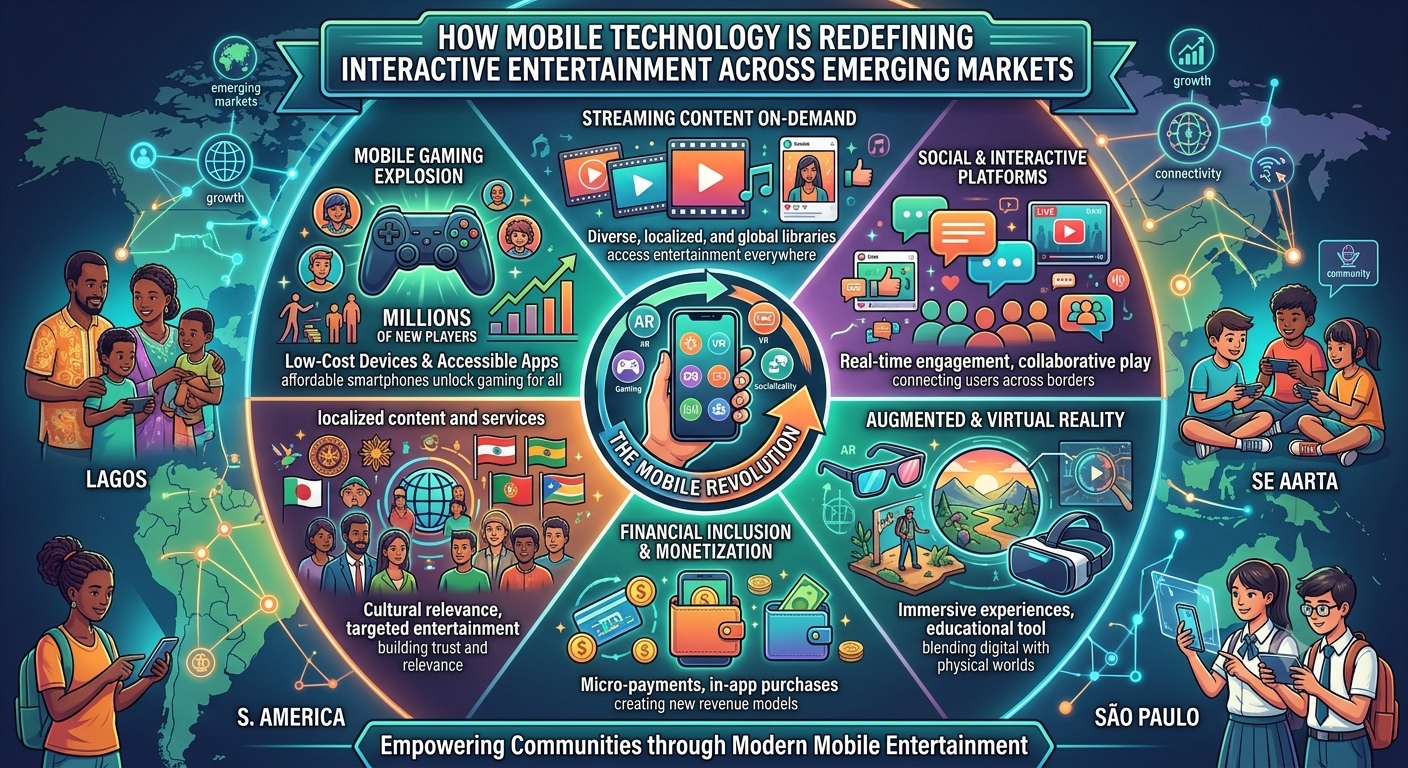
How Mobile Technology Is Redefining Interactive Entertainment Across Emerging Markets
A friend who works in ed-tech told me something a few years back that stuck with me. In parts of rural India, she said, the first screen a teenager touches usually isn't a TV. It's a phone, often shared with three siblings, passed around like a paperback everyone's waiting to read next. No desktop phase. No dial-up years. Straight to mobile.
That detail matters more than it sounds like it should. Smartphones in these regions have quietly become the main entry point for education, banking, shopping, and a growing pile of interactive experiences that simply didn't exist for these users ten years ago. Affordable data plans keep spreading faster than most infrastructure planners expected, and new users keep showing up online with expectations built entirely around what a phone can do. Not a laptop. A phone.
This isn't a story about more screen time. It's about what people now expect technology to deliver, full stop: fast, cheap, and flexible enough to work on whatever's actually in their pocket.
Emerging Markets Stopped Just Copying and Started Leading
There used to be an assumption, mostly unspoken, that developing economies would eventually catch up to whatever Silicon Valley or Seoul had already figured out. That's aged badly. Teams building for these markets have learned something the rest of the industry is now stealing back: users there tend to care less about flash and more about whether the thing actually works when the connection drops to two bars.
So apps get built lean. Entry-level hardware, patchy 3G, batteries that need to last a whole workday without a charger in sight. Developers lean on lightweight architecture, responsive web frameworks, cloud delivery that doesn't fall apart the second bandwidth gets scarce.
Here's the part people miss. Designing for constraint doesn't just widen access. It sharpens the product. Teams that build for the toughest conditions first tend to end up with something leaner and more durable everywhere else too.
Always-On Connectivity Rewired What People Expect
Cheap mobile data changed something fundamental. Once always-on internet stopped being a luxury, people quit treating devices as separate tools for separate jobs. Work bleeds into messaging, which bleeds into shopping, which somehow ends with someone watching a cooking video at 11 pm. All on the same six-inch screen.
Companies had to adjust. Convenience and cross-platform compatibility went from "nice extra" to baseline requirement almost overnight. Firms that spent a decade perfecting their desktop site suddenly realized the phone had become the actual front door, and the desktop was more of a side entrance nobody used anymore.
It doesn't stop at layout, either. Performance benchmarks changed. Cloud sync became mandatory instead of optional. Personalization stopped being a feature and became an assumption. Building "mobile-friendly" used to just mean shrinking a website. Now the phone comes first, and everything else gets built around it.
Interactivity Broke Out of Its Old Boxes
Digital entertainment doesn't sort itself into tidy categories anymore, and honestly, trying to force it into old ones misses what's actually happening. Language-learning apps now run achievement systems that wouldn't look out of place in a mobile game. Fitness trackers turn a solo jog into a leaderboard battle against strangers three time zones away. Even professional networking tools have started leaning on recommendation engines that feel less like a feed and more like something built specifically for you.
What connects all of it is a change in how people relate to software. Nobody wants to just sit there and consume anymore. People want to poke at things, shape outcomes, see their choices reflected back. That habit got trained into users by years of apps rewarding participation over passivity, and there's no putting that toothpaste back in the tube now.
Community Turned Into the Real Competitive Moat
Something shifted once mobile connectivity got reliable enough to stay on constantly, not just when someone happened to be near WiFi. People started building actual communities inside apps rather than just using apps solo. Discussion threads. Shared challenges. Rankings that turn strangers into rivals, and sometimes into friends.
Desktop software never quite pulled this off the same way. You don't need special equipment or a fixed location to check in on people you care about anymore. Just the phone already sitting in your hand.
For any platform chasing loyalty over the long haul, this community layer has become the strongest retention tool available, arguably stronger than the actual product features themselves. Leaving an app is a lot harder when leaving means losing touch with actual people.
The Boring Stuff Still Matters Most
None of the community momentum means much if the app itself lags, crashes, or eats through someone's battery in forty minutes. Behind every mobile product that's actually stuck around sits a pile of unglamorous engineering work. Performance tuning. Navigation that doesn't require a manual. Layouts that behave properly whether someone's on a five-inch budget phone or a six-and-a-half-inch flagship. Resource management tight enough that the phone doesn't feel hot to the touch after twenty minutes.
HTML5 improvements, better cloud infrastructure, and smarter adaptive interfaces have made it genuinely realistic to deliver a consistent experience across wildly different operating systems now. Instead of maintaining separate silos for iOS and Android and everything in between, most serious teams aim for one unified environment users can move through without noticing the seams.
That approach pays off twice. Older devices get better access, and engineering teams stop drowning in five parallel codebases.
Where Interactive Entertainment Actually Goes From Here
Entertainment remains the clearest window into how far this has all come. Streaming platforms, live content, learning tools, interactive apps- all of it has ridden the same wave of better hardware and steadily improving networks, and the pace hasn't let up.
Developers now build for participation rather than passive viewing almost by default. Personalization and cloud sync used to be premium extras. Now people expect them the way they expect running water.
Which is part of why industry watchers keep circling back to skill-based online games, titles that reward genuine strategic thinking rather than pure luck, wrapped in the kind of accessibility that only widespread mobile technology could deliver. A whole generation grew up expecting games to respect their time and their intelligence, and these titles are the answer to that expectation, not a coincidence riding alongside it.
Monetization Grew Up Too
Business models matured right alongside the audience. Flat upfront pricing and ad walls that interrupt every thirty seconds- that playbook is mostly dead now. Battle passes, cosmetic purchases, tiered subscriptions, rewarded engagement loops- these dominate instead, mostly because they let developers earn without punishing the people just trying to enjoy themselves.
That shift says something about mobile entertainment as a category more broadly. The platforms figuring out the right balance tend to be the ones people stick around with for years, not weeks, because sustainable revenue turns out to depend on respecting a player's trust rather than squeezing every last interaction for value.
The Same Playbook, Different Industries
None of this is happening in a vacuum, either. The exact same technologies reshaping entertainment are opening doors in healthcare, education, finance, logistics, retail. AI now handles a growing chunk of customer service. Cloud computing makes real-time collaboration possible across time zones that used to make coordination genuinely miserable. Data analytics replaces guesswork with something closer to an actual answer. Mobile platforms connect businesses to customers more directly than storefronts or call centers ever managed.
Responsiveness ties it all together. Services need to scale, adapt, and reach people who got locked out of earlier waves of digital adoption entirely. As infrastructure keeps improving across emerging markets, the companies betting on mobile-first development right now are probably the ones still standing a decade from now. Probably, not definitely. Nobody gets to be certain about that.
What This Actually Adds Up To
Mobile technology stopped being a convenience a while back. It's the foundation now, whether that's a banking app in Lagos or a scrappy multiplayer game built out of a bedroom studio in Manila. Its reach goes well past communication these days, shaping how businesses run, how communities form, how people spend the thirty idle minutes before bed.
Analysts tracking where this goes next keep circling the same three ideas: accessibility, cross-platform flexibility, design that actually puts the user first instead of chasing the platform's own metrics. Those three will likely define whatever comes next in interactive mobile experiences, though the specifics will probably surprise everyone anyway.
For developers, businesses, and the people just using this stuff every day, this isn't really a story about faster phones or slicker apps. It's a genuine shift in how digital experiences get made, shared, and enjoyed, especially across emerging markets, where the innovation increasingly starts from the ground up instead of trickling down from wherever it was invented first.
Event Information
 Event Venue:
 Date:
Date:
 Phone:
 Website:
 Address:
 Ticket Rate:







Add Your Directory With Us
Boost your visibility with our Business Directory

Add Your BCard With Us
Open the door to new professional connections.
DayOfDubai
Business Services
