

Prototypes for Humanity 2026 Brings 52 Global Researchers to Dubai, Awards USD 50,000 for Methane-to-Hydrogen Innovation

Prototypes for Humanity’s 2026 Short Papers Platform has brought together 52 researchers from 49 universities across 27 countries in Dubai, showcasing academic research aimed at addressing global challenges through practical, industry-focused solutions.
Held in strategic partnership with ICD (Investment Corporation of Dubai), the four-day conference took place from November 17 to 20, alongside the annual Dubai Future Solutions – Prototypes for Humanity Summit. The initiative attracted more than 700 submissions from academics at universities worldwide.
The platform connects university research with industry priorities, encouraging collaboration and helping translate scientific ideas into solutions with potential for real-world application.
Research Across Seven Strategic Themes
The 2026 edition featured research across seven themes covering areas relevant to Dubai's economic and development priorities. These included autonomous systems and advanced manufacturing; mobility and logistics; wellbeing and human performance; infrastructure and cities; environment, sustainability and energy; socio-economic empowerment, digital economies and future markets; and open and speculative research.
During the conference, researchers presented their work to fellow academics and representatives from industries including aviation, energy, financial services, real estate and healthcare. Representatives from ICD portfolio companies also attended sessions, creating opportunities to explore how emerging research could support business innovation and industry needs.
USD 50,000 Award for Methane Conversion Research
One of the main highlights was the presentation of the USD 50,000 Best Short Paper Award to Dr Abdelaziz Gouda, a research associate in the Department of Chemical Engineering at the University of Waterloo, Canada.
Presented by Douraid Zaghouani, Chief Operating Officer at ICD, the award recognised Dr Gouda's research titled Light, Not Flame: A Single-Step Photolysis Prototype Turning Waste Methane into Battery-Grade Carbon Nanotubes and Clean Hydrogen.
The research uses light to convert waste methane into clean hydrogen and battery-grade carbon nanotubes through a single-step process. It aims to transform methane, a potent greenhouse gas, into valuable materials for clean energy and battery supply chains.
The research addresses a significant environmental and industrial challenge. The global oil and gas sector is estimated to vent around 200 billion cubic metres of methane and flare another 150 billion cubic metres of natural gas annually. Methane also has approximately 80 times the warming effect of carbon dioxide over a 20-year period.
Dr Gouda said receiving the ICD Award validated CarbonLume's approach and its potential for practical application. The funding will support the next development stage, including the construction and testing of a first 1kg-per-day module.
Best Paper Awards Across Seven Categories
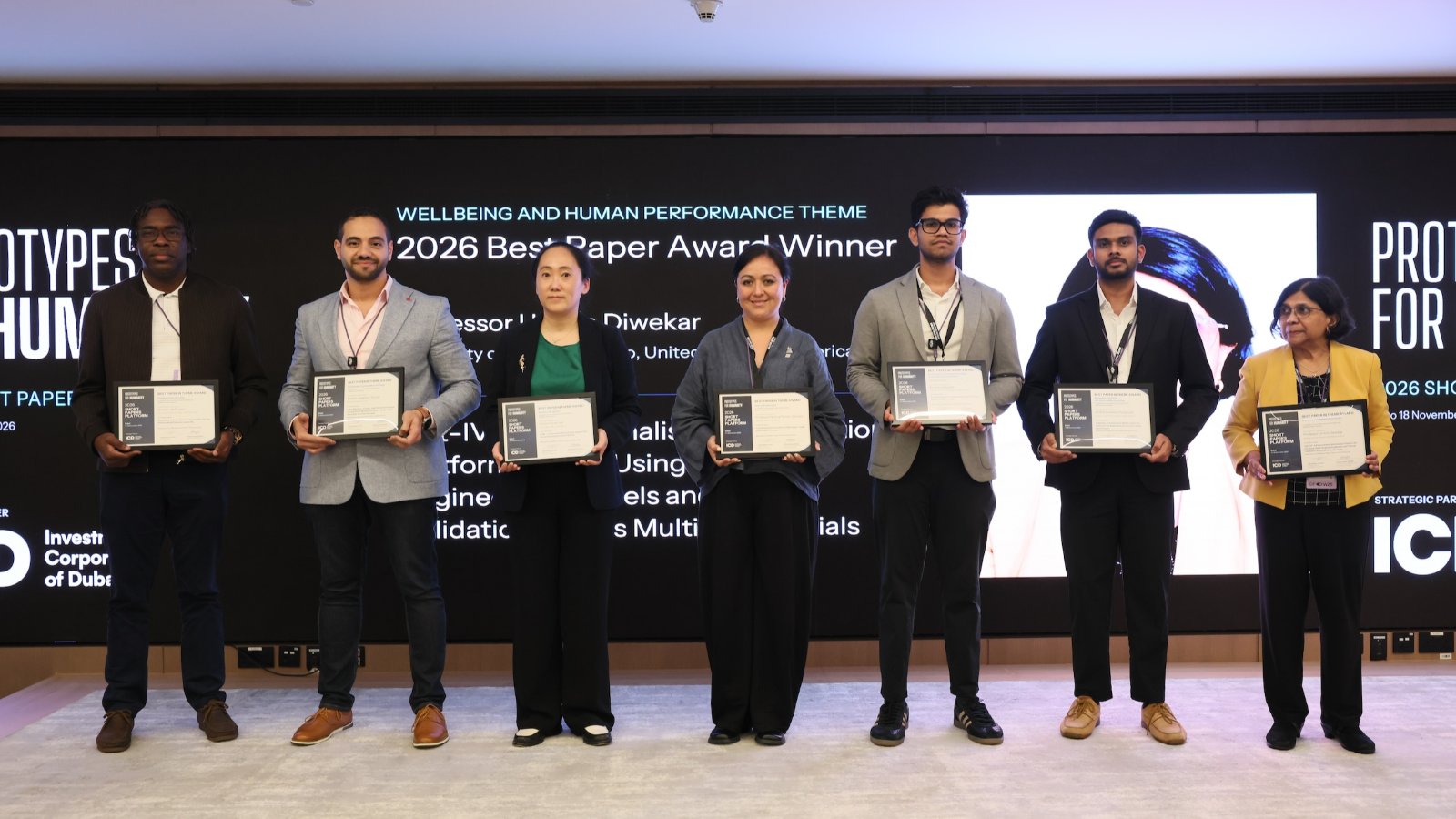
Researchers received Best Paper Awards across the platform's seven themes, recognising work with potential for practical application.
-
Autonomous Systems and Advanced Manufacturing: Rishivarathan Ilangovan from the Singapore University of Technology and Design was recognised for Dragonfly: An Autonomous Robotic System for Chemical-Free Aedes Mosquito Control in Urban Environments. The autonomous robot captures dengue-carrying mosquitoes in occupied public spaces without chemicals and maps areas where mosquito populations concentrate. The project was also Highly Commended by ICD.
-
Mobility and Logistics: Dr Yijing Li from King's College London received recognition for AI/ML-Enhanced Satellite Tracing of Supply Chain Disruptions during Extreme Flooding. The research uses satellite imagery and artificial intelligence to assess how floods affect freight networks, drawing on case studies from Spain's 2024 floods and flooding in Dubai in 2023 and 2024.
-
Wellbeing and Human Performance: Professor Urmila Diwekar from the University of Illinois Chicago was recognised for Opt-IVF: A Personalized Optimization Platform for IVF Using Hybrid Engineering Models and Clinical Validation Across Multicenter Trials. The platform personalises hormone dosing during IVF and was evaluated across approximately 1,000 patients in four clinical studies. In the largest trial, it was associated with a 42% increase in clinical pregnancy after the first embryo transfer and a 21% reduction in hormone use.
-
Infrastructure and Cities: Two researchers were jointly recognised. Dr Lee P Leon from The University of the West Indies, Trinidad and Tobago, was awarded for research into converting waste materials into a cost-effective road pavement repair mix. Professor Hamidreza Norouzi from City University of New York, United States, was recognised for research using machine learning and satellite data to map street-level air temperatures and support heat-resilient urban planning.
-
Environment, Sustainability and Energy: Dr Abdelaziz Gouda from the University of Waterloo received recognition for his methane conversion research, which also secured the USD 50,000 ICD award.
-
Socio-Economic Empowerment, Digital Economies and Future Markets: Nithul Bagathi from the Singapore University of Technology and Design was recognised for Smorphi Imaginary Pro: Robotics Education for Every Learner at USD 1 a Month. The browser-based programme aims to make robotics and computational thinking more accessible to learners from age 10 through university.
-
Open and Speculative: Professor Patricia Torres-Sánchez from Tecnológico de Monterrey, Mexico, received the award for Translating Water Innovation in Public Space: Visible and Invisible Prototypes. The research explores how interactive public installations can make scientific work on water quality more accessible and understandable.
Audience Choice Award Recognises Wave Energy Research
The Audience Choice Award, determined by votes from conference attendees, went to Brathikan Vijayamohan Mankayarkarasi from Kumaraguru College of Technology, India, for Parametric CFD Investigation of a Differential Heave Wave Energy Converter for Distributed Coastal Energy Access.
The research uses computational fluid dynamics to optimise a wave energy converter designed for smaller, near-shore applications. It aims to support affordable, community-scale electricity generation in coastal areas where access to reliable power remains a challenge.
The converter is the core technology behind Kinowave, which won the UK National James Dyson Award in 2025.
Industry-Academia Collaboration
Douraid Zaghouani said the platform demonstrated how collaboration between academic institutions and businesses can help turn research into practical solutions. He added that ICD portfolio companies had the opportunity to engage directly with researchers, explore emerging ideas and identify applications aligned with their innovation priorities.
Tadeu Baldani Caravieri, Managing Director of Prototypes for Humanity, said the initiative aims to bring academic expertise to challenges faced by society, governments and organisations. He highlighted research spanning emissions, clean energy, resilient infrastructure, remote monitoring, wellbeing and environmental sustainability.
Research Proceedings to Be Published in 2027
All papers presented at the conference will be formally published in the Short Papers Platform Conference Proceedings in early 2027. The collection will be an indexed, ISBN-registered volume and distributed internationally.
The call for abstracts for the 2027 edition is scheduled to open in March, continuing the platform's effort to connect global academic research with industry needs and practical applications.