
Strategic Importance of Mixed Case Palletizing in Modern Distribution Centers
The distribution centres in Saudi Arabia are facing increasing pressure to deliver orders faster and at a reduced cost of operation. With the number of retail outlets increasing and the demands of consumers escalating, the manner in which the distribution centres build and dispatch pallets has emerged as a key factor in the efficiency of their operations in warehouse automation environments. Centres that neglect to optimise their palletising processes risk falling behind in meeting service levels.
The process of palletising cases of varying sizes, weights, and SKUs, known as mixed case palletizing, is at the centre of this paradigm shift. As far as Saudi Arabia is concerned, and in particular distribution centres that cater to the retail, grocery, and e-commerce markets, this is a process that needs to be mastered in order to remain competitive within modern warehouse automation operations.
Why Case Palletizing Matters More Than Ever?
Traditional case palletizing, where similar cases are stacked in an orderly fashion, is still applicable in bulk distribution. But in today’s retail scenario, there is a need for store-ready pallets that have a combination of various SKUs in a predetermined order supported by warehouse automation solutions.
This is a time-consuming and error-prone process when carried out manually. The end result is an unstable pallet load, damage during transit, and rejected shipments. The financial implications of such errors can be substantial in high-volume operations.
End-of-Line Palletising and Its Impact on Throughput
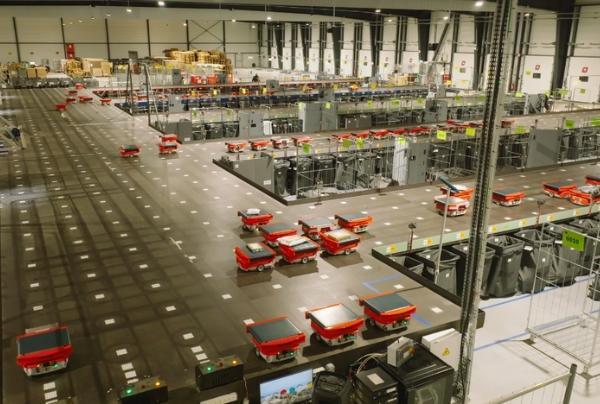
End of line palletizing is the last stage in the warehouse’s outbound process, where products are consolidated into pallets for shipment within warehouse automation systems powered by AMRs such as Addverb’s Dynamo. Bottlenecks in this area have a direct impact on throughput, truck usage, and accuracy of delivery.
Distribution centres in Saudi Arabia, catering to major retail chains, are increasingly focusing on this step as a major area of improvement, realising that any issues at the end-of-line area have a ripple effect on the entire supply chain.
Driving Warehouse Productivity Improvement Through Smarter Builds
Warehouse productivity improvement involves more than just speed. It includes factors such as stability, labour efficiency, and sequencing accuracy. If these are properly addressed, the following improvements can be realised in Saudi Arabia warehouses:
- Fewer damaged goods in transit
- Better cube utilisation within trucks
- Reduced manual labour hours per pallet
- Faster pallet completion aligned with dispatch schedules
- Consistent build quality across high-volume order profiles
More intelligent palletising designs will also minimise rework and re-palletising, which are the hidden costs of manual operations. In warehouse automation environments, such improvements can also be supported by Addverb’s Autonomous Mobile Robot (AMR), Dynamo, for material movement and sorting robot, Zippy, for high-speed parcel sorting.
The Rise of Automated Mixed Case Palletizing
Automated mixed case palletizing takes the challenge of multi-SKU pallet building and transfers it to intelligent systems that are capable of handling large volumes of cases accurately. This is achieved through a combination of robotic technology and software within warehouse automation environments, which also deploy systems such as sorting robots like Addverb’s Zippy for material flow. This enables a faster and more accurate outbound process that grows with the business.
What Does a Robotic Case Palletizer Deliver?
A robotic case palletizer employs the use of programmable arms, vision, and artificial intelligence algorithms to pick, orient, and place cases in a predetermined sequence. Unlike traditional mechanical systems, a robotic palletizer is capable of handling cases of different sizes and weights without the need for extensive changeovers, making it ideal for distribution centres in Saudi Arabia that handle fast-moving product categories.
Core Capabilities of Modern Robotic Palletizing Systems
The latest technology provides real-time 3D pallet planning, dynamic gripping for various case sizes, smooth interface with warehouse management systems, and error detection to identify unbalanced structures before they get to the dock. This ensures that pallets are of high quality even when SKU complexity is high.
How Addverb Supports Automated Mixed Case Palletizing in Saudi Arabia
Addverb is a worldwide robotics and warehouse automation solutions provider that offers comprehensive automation solutions for material movement, storage, sorting, and picking.
Addverb assists distribution centres in integrating robotic palletising with the picking and sorting processes, allowing for high-speed pallet builds that meet the required specifications of the retail and logistics companies in the region. The solutions can be scaled according to business requirements, making them a feasible long-term investment.
Conclusion
With increasingly complex supply chains and order profiles, mixed case palletizing has emerged as a key focus area for contemporary distribution centres. For Saudi Arabia-based facilities seeking to enhance processing rates, minimise errors, and expand capacity, the collaboration with Addverb provides a clear roadmap, leveraging successful robotics and smart software designed to meet the challenges of the contemporary logistics environment.








Add Your Directory With Us
Boost your visibility with our Business Directory

Add Your BCard With Us
Open the door to new professional connections.
DayOfDubai
Business Services
